What is design thinking?
Design thinking in one sentence
Design thinking is a way of thinking that supports solving problems and creating new, innovative solutions based on a deep understanding of the needs of the people who will use them.
Design is a way of solving problems
Look around you. Take a chair, for example. This seemingly simple everyday object is the result of a great many careful decisions. The height of the seat was chosen so that your feet rest comfortably on the floor. The backrest is tilted at an angle that supports the natural curve of the spine. Every detail serves one purpose: comfortable sitting.
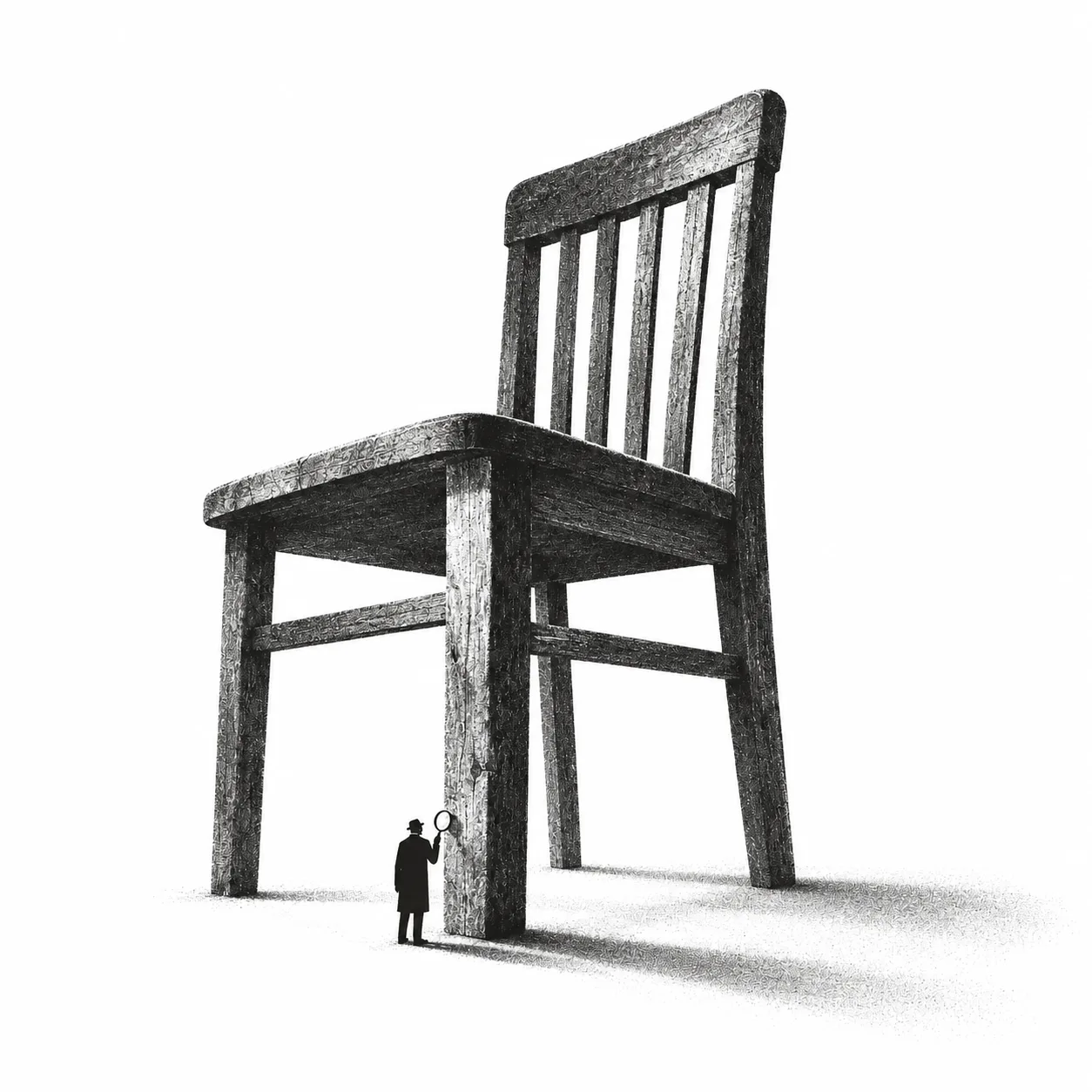
All of this, from a simple chair to complex social systems, came about through deliberate design decisions. It is meant to meet accepted standards and satisfy specific needs. As Nobel laureate Herbert Simon put it, everyone designs who devises courses of action aimed at changing existing situations into preferred ones. Design therefore goes far beyond the aesthetics, form and styling commonly associated with it. It is a way of solving problems.
When design fails
Paradoxically, the best design often stays invisible: we only notice it when something does not work. Remember that frustrating moment when you stand in front of a door, confidently grab the handle and pull, and the door does not budge. Then you notice the sign: “PUSH”. Donald Norman, a cognitive scientist, an expert in user-centred design and the author of The Design of Everyday Things, made this situation a symbol of design errors. As he stresses, in such a case the mistake is the door’s, because it was badly designed. An object should communicate how to use it through its form alone, with no need for extra signs or labels.
People at the centre
Design thinking grew out of such everyday frustrations: an approach that puts people at the centre of the design process. It is a mindset more than a set of rigid rules (which is exactly why design is followed by thinking). The whole process starts with a simple yet revolutionary question: what does this person really need? Design thinking encourages us to set aside our own assumptions and see the world through someone else’s eyes, noticing obvious needs as well as deeply hidden desires, fears and constraints.
When we design with this awareness, whether it is a waste sorting system, an app that motivates people to exercise or a university class, we create solutions that fit naturally into the way people think and act. Well-designed objects and systems need no manual and no training. They are intuitive and let us focus on the goal instead of the tool. They simply work.
The stages of design thinking
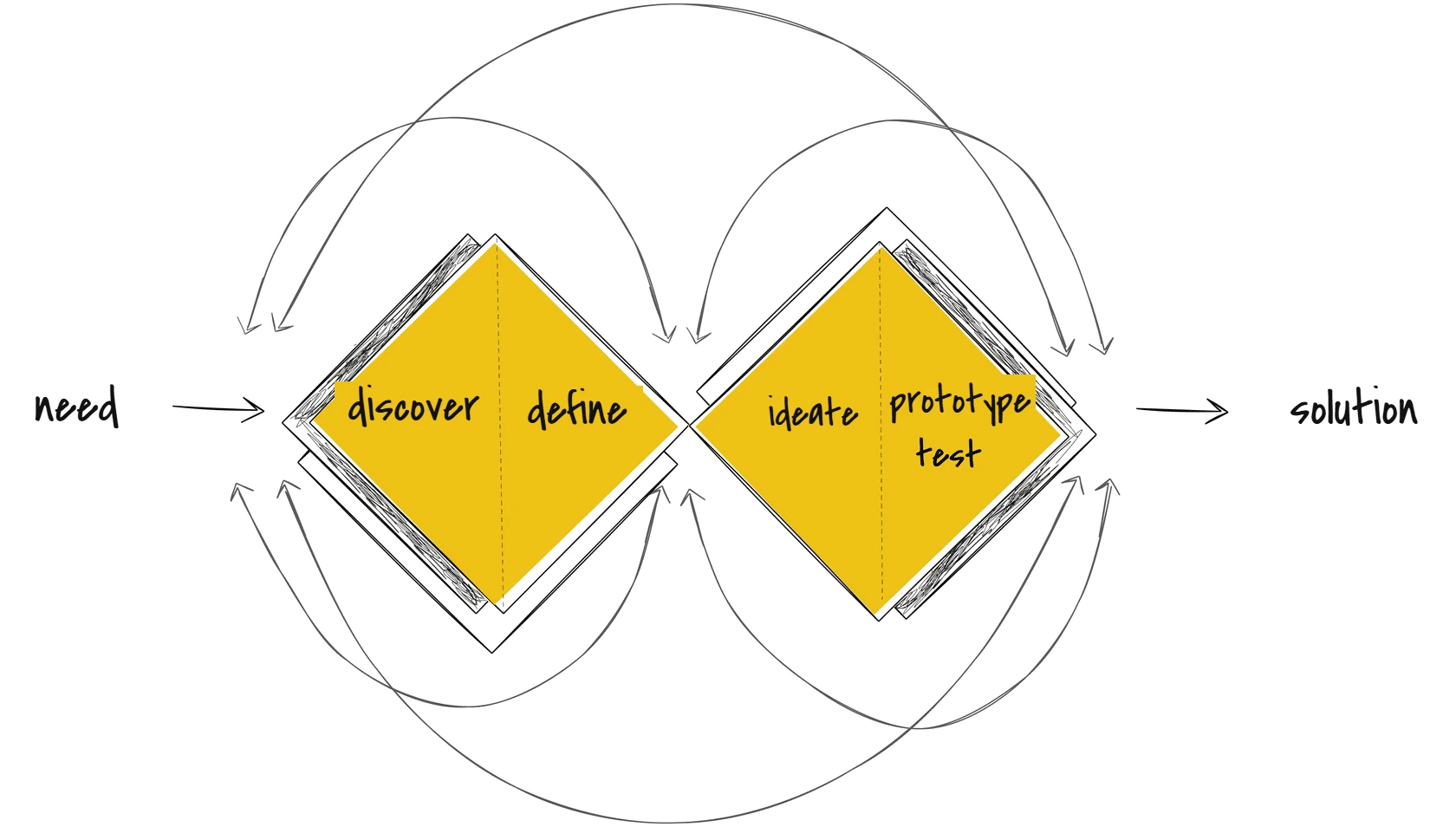
Design thinking starts with a careful study of people’s needs and ends with tested solutions that respond to them. All of this is gathered into an ordered framework of five main stages: discover, define, ideate, prototype and test.
These stages are often shown as the double diamond model, an alternating cycle of divergent and convergent thinking:
- Divergent thinking – looking for many possible ways to solve a problem and looking at the problem from different perspectives. It requires creativity, openness and flexibility. We gather as much information and as many ideas as we can.
- Convergent thinking – looking for the best solution. It requires focus, a methodical approach and attention to detail. We squeeze the most important and the best out of the information and ideas we have gathered.
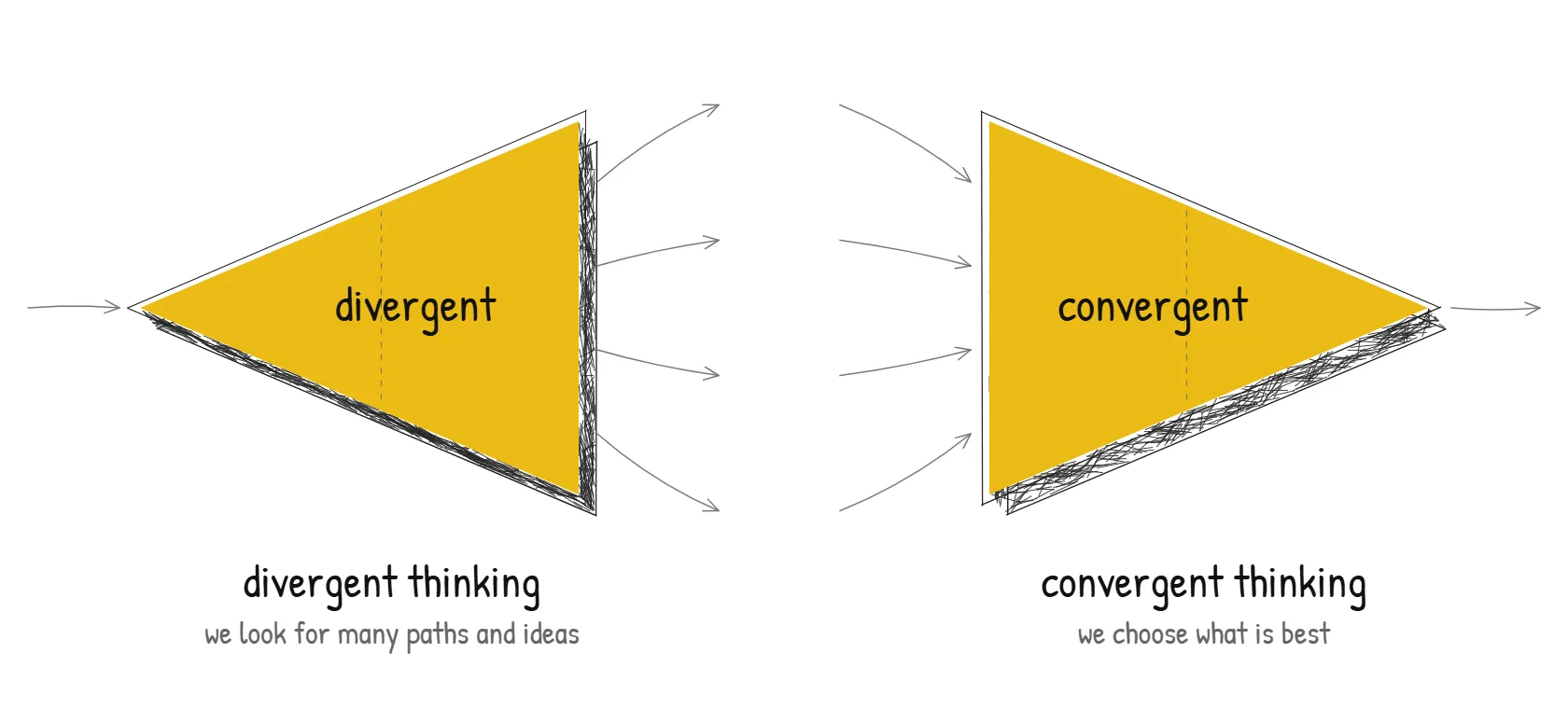
We begin the first stage of design thinking by widening our perspective. This calls for divergent thinking and curiosity. It is the time, crucial for the whole design process, to discover, explore and understand deeply. Then, in the define stage, we analyse and organise the information gathered so far. By narrowing down and thinking convergently, we name the problem precisely. Equipped with this knowledge, now well organised, we enter the third stage, in which we ideate: we look for ideas that answer a well-defined problem, generating as many as possible and returning to creative, divergent thinking. The next stage narrows our focus once again to a single, best solution. Our aim is to build a prototype that gives the idea a concrete, tangible form, and then to test it to see how the solution works (or could work) in reality. This is the stage in which the creators’ vision is checked by potential users. The design thinking process ends with implementation, that is, putting the solution into practice.
Why does this structure work?
Each stage builds on the previous one. Without discovery, sometimes called “empathy” in the literature, we diagnose the wrong problems. Without defining, we generate ideas that miss the most important needs, pains and gains of the users. Without the ideation stage we build a solution on the first concept that came to mind. Without prototyping we test half-baked, abstract ideas. And without testing we create solutions that will most likely fail to work and fail to solve the problem.
This alternating rhythm of thinking has a clear purpose: it protects us from jumping to solutions too early and keeps us from getting stuck in endless analysis. It echoes the philosophy of fail fast, fail often.
An important feature of design thinking is its iterative, non-linear nature. The five stages are loops of corrections and continuous improvement, more than items on a list to be ticked off once. In a traditional approach, changing direction late in the process means failure and loss. In design thinking it is proof that the process works: that we really listen to users and respond to what they tell us.
An example: Doug Dietz and the MRI scanner
Doug Dietz of General Electric led the team that designed a magnetic resonance imaging (MRI) scanner. After two years of intensive work, once the machine reached hospitals, Dietz wanted to see how it performed in everyday medical practice. The problem showed up almost at once. Dietz noticed a terrified little girl clinging to her parents and soon bursting into tears. After several failed attempts to persuade her to have the scan, the staff called an anaesthetist. Sedating children before an MRI, it turned out, was very common.
Dietz began by getting to know the perspective of his young patients. He met children and paediatricians and listened to their needs. The result? He designed new versions of the scanners that turned the children’s attention away from the examination and towards a wonderful adventure: sailing a pirate ship or flying a space mission. Patient satisfaction rose by 90%. Yet what pleased Dietz most was not the statistics. It was a question one of the girls asked after her scan: “Can we come back tomorrow?”
Design thinking democratises innovation
Design thinking turns out to be a method that, to some extent, democratises innovation. It works without access to costly research laboratories or million-dollar budgets. What it does require is:
- readiness to listen to and observe other people,
- humility about your own assumptions,
- courage to test ideas again and again,
- learning from users.
Wicked problems
Design thinking is especially valuable for so-called wicked problems: problems with no single obvious solution and no fixed boundaries. The method is used in a wide range of fields, from designing technology products and solving business challenges to social issues. The more multidimensional and unpredictable a problem is, the more valuable an approach that puts people at the centre and allows solutions to be improved step by step.
What next?
Anyone can create innovation. At the Design Thinking Lab we support those who want to see it for themselves. Explore our materials.

Sources
M. Gołębiowska, G. Kwiatkowski, M. Bielicki, Laboratorium Design Thinking. Przewodnik metodyczny dla nauczycieli akademickich (in Polish). H.A. Simon (1969), The Sciences of the Artificial, MIT Press. D. Norman (2013), The Design of Everyday Things, Basic Books. T. Kelley, D. Kelley (2013), Creative Confidence, Crown Business. H. Rittel, M. Webber (1973), Dilemmas in a General Theory of Planning, “Policy Sciences”, no. 4.
Read next

Oblique Strategies for the Algorithm
In 1975 a small black box appeared. Title: Oblique Strategies. Inside were cards with short, enigmatic sentences…
Creative traces
A sandwich holder, a notebook on wheels and a key with a torch. What do these three objects have in common?
Tell it to someone…
Imagine waking up in the year 1726. You are in a cottage, at a table…

Design Thinking Toolkit
Looking for more inspiration?
Warm-ups, tools, videos, stories and data for working with the design thinking method. Pick one and get started.
Open the toolkit →