
Tell it to someone…
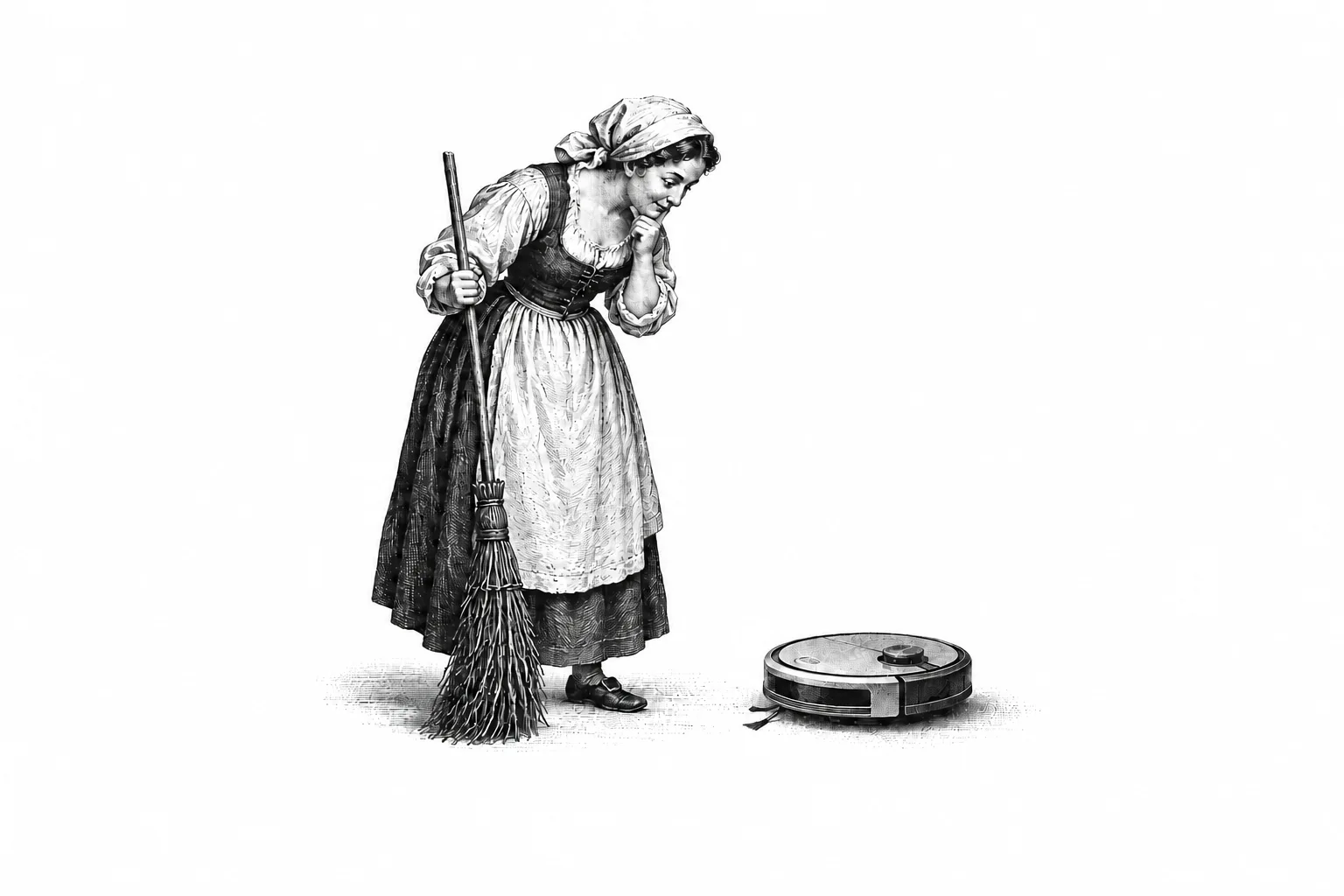
Imagine waking up in the year 1726.
You are in a cottage, at a table. The woman of the house sets a mug of milk in front of you, sits down opposite and asks where you are from and what life is like there. In the corner her daughter is sweeping the earthen floor. You look at that broom and you already know what you will talk about. A robot vacuum cleaner.
You begin.
That it is an autonomous mobile robot equipped with a navigation system. That it uses algorithms to simultaneously localise its own position and map the room, and then computes an optimal trajectory so as to maximise surface coverage and limit redundant movement. That a set of infrared sensors, proximity detectors and sensors that register changes in height lets it avoid obstacles and protects it from falling. That the motor generates negative pressure in the suction channel, the main brush collects debris from the surface, and the side brushes transport it from the edges towards the suction module. That it communicates over a wireless network with a mobile app and synchronises data with the cloud. That at the end of a cycle it uses stored coordinates to return autonomously to its docking station, where it automatically initiates charging of its lithium-ion battery.
The woman looks at you politely. Her daughter stopped sweeping for a moment to listen, and soon went back to her broom…
You begin a second time.
That at home you have a small device, roughly the size of a plate. In the morning you go out, and it drives around the floor by itself, picking up dust and crumbs. It goes around chairs and other obstacles, stops before the stairs, slides under furniture. When it has finished, it returns to its place. And in the evening you come home to a clean floor.
Now both women know what you are talking about. The second version worked, because a good story in 1726 and a good story in 2026 have the same job: to turn something foreign into something a person can picture.

The listener from 1726 sits in every meeting
When we talk about our idea, it is very easy to slip into details. Platform, algorithm, module, integration, artificial intelligence. This is the language we have used for weeks while working on the solution, so naturally it is the first to appear.
The trouble is that the person on the other side of the table usually has other questions before “how does it work?”. First they try to understand what will actually change for them. What will be simpler, faster, more convenient. What will disappear from their list of problems.
I see this regularly in workshops. A team works on a solution for a week, two, three. Finally the moment of presentation comes and the first thing we hear is:
“We have created a platform integrating data from various systems, using automatic synchronisation, a central information repository and a real-time notification mechanism.”
After a short warm-up, which we run under the distinguished name “1726”, the same idea starts to sound different:
“When the work schedule changes, the employee finds out right away.”
Take up the challenge
Would you like to try it yourself?
You draw one object or one service from the year 2026. Your task is to describe it to the person next to you as if they came from 1726.
There is one rule: they have to understand what you are talking about.
This simple exercise works very well at the start of a workshop, in class with students or just before a team presentation. It helps you step out of the language of your own project for a moment and check whether anyone besides you understands what you actually want to say. The other person plays an inhabitant of 1726, catches every word that sounds foreign to them and asks for an explanation until the story becomes clear.
And finally, try something harder.
Take the project you are working on right now. The one you talk about most often. And describe it as if someone from 1726 were sitting on the other side of the table.
How did it go?
Read next

Oblique Strategies for the Algorithm
In 1975 a small black box appeared. Title: Oblique Strategies. Inside were cards with short, enigmatic sentences…
Creative traces
A sandwich holder, a notebook on wheels and a key with a torch. What do these three objects have in common?


Design Thinking Toolkit
Looking for more inspiration?
Warm-ups, tools, videos, stories and data for working with the design thinking method. Pick one and get started.
Open the toolkit →